

The report, published in Nature, reveals that polyamines bind to specific domains in proteins and operate as a metabolic shield against modifications in their structure. This mechanism is illustrated by the regulation of the spliceosome, a protein complex that determines the mature form and composition of RNAs, and that links metabolism to processes that are instrumental in the control of cell identity and function.
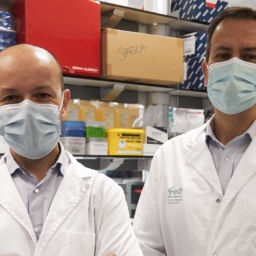
The work was led by Dr. Arkaitz Carracedo, Ikerbasque Research Professor, head of the Cancer Cell Signaling and Metabolism Laboratory at CIC bioGUNE (member of BRTA) and group leader in CIBERONC, with Dr. Amaia Zabala-Letona and Dr. Mikel Pujana-Vaquerizo as co-first authors. The study was carried out with the collaboration of the VHIO Gene Expression and Cancer Group, led by Dr. Joan Seoane, ICREA professor and Director of the VHIO Program in Immuno-oncology and Tumor Microenvironment.
This body of work represents an international collaboration involving more than 25 institutions, including CIC bioGUNE, CIBERONC and CIBERehd, Ikerbasque, the Centre for Genomic Regulation (CRG), the Spanish National Cancer Research Centre (CNIO), Memorial Sloan Kettering Cancer Center (USA), the Children’s Hospital of Philadelphia and the University of Pennsylvania (USA), the University of Zurich and University Children’s Hospital Zurich (Switzerland), the Vall d’Hebron Institute of Oncology (VHIO), the Vall d’Hebron Research Institute (VHIR), the Universitat Autònoma de Barcelona (UAB), and the Universitat Pompeu Fabra (UPF).
(Bilbao, January 14th, 2026). Polyamines are small molecules naturally present in all cells and are critical in guiding cellular decisions, whereas an alteration in the abundance of these metabolites is invariably observed in pathological scenarios such as cancer or ageing. Despite decades of research, the mechanisms through which polyamines control cellular decisions has remained obscure.
The collaborative study led by scientists in CIC bioGUNE, reports the discovery of a mechanism that reformulates our understanding about the actions of polyamines in health and disease. Using an integrated approach that combined molecular simulations, biochemical and structural analyses, proteomics, and cellular assays, the scientific team identified that these metabolites alter the phosphoproteomic landscape, which has important repercussions for protein function. They focus on proteins that take part in the control of alternative splicing, a process that alters that repertoire of RNAs and proteins in our cells. The research team could pinpoint the recognition mode of polyamines on target proteins and demonstrate that this process can be disrupted or potentiated through genetic or pharmacological means. With hundreds of proteins exhibiting potential polyamine-binding motifs, this study opens the door for a renewed perception of polyamine-regulated cellular responses.
Polyamines are overproduced in cancer, and their loss is associated to the process of ageing. In turn, inhibiting polyamine metabolism through pharmacological approaches has been evaluated in different cancers, and it is currently employed as a therapeutic strategy in neuroblastoma. Conversely, dietary polyamine supplementation is posed as an innovative strategy to counteract ageing. The findings of Zabala, Pujana and colleagues could contribute to elucidate the effectors of polyamines in these processes, thus helping in the design of next-generation dietary and pharmacological interventions.
The research was funded through competitive calls from Spanish and European research programs, including national agencies, CIBER biomedical networks, the Spanish Association against Cancer (AECC), regional funding bodies, and institutional support from participating centers, as well as additional international funding for cancer and basic biomedical research.
Reference: Amaia Zabala-Letona, Mikel Pujana-Vaquerizo, Belen Martinez-Laosa, Maria Ponce-Rodriguez, Saioa Garcia-Longarte, Isabel Mendizabal, Ana Gimeno, Malgorzata Rogalska, Joycelyn Tan, Diana Cabrera, Sebastiaan van Liempd, Pilar Ximenez-Embun, Sergio Espinosa, Maider Fagoaga-Eugui, Francesca Peccati, Maciej Zakrzewski, Ianire Astobiza, Mikel Arana-Castañares, Sarah Cherkaoui, Maria Sendino, Inés Martín-Barros, Amaia Ercilla, Laura Bozal-Basterra, Onintza Carlevaris, Amaia Arruabarrena-Aristorena, Encarnación Pérez-Andrés, Telmo Santamaría-Zamorano, Juan A. Ferrer-Bonsoms, Fernando Carazo, Maciej Cieśla, Cesar Lobato, Joan Seoane, Natalia Martín-Martín, Rosa Barrio, James D. Sutherland, Ana M Aransay, Juan Manuel Falcón-Pérez, Barbara Martínez-Pastor, Angel Rubio, Francisco J Blanco, Michael D. Hogarty, Raphael J. Morscher, Edurne Berra, Remigiusz A. Serwa, Jesús Jiménez-Barbero, Gonzalo Jiménez-Osés, Alejo Efeyan, Lydia Finley, Jose M Lizcano, Javier Muñoz, Juan Valcarcel & Arkaitz Carracedo. Polyamine-dependent metabolic shielding regulates alternative splicing. Nature. DOI: 10.1038/s41586-025-09965-1