

Summary:
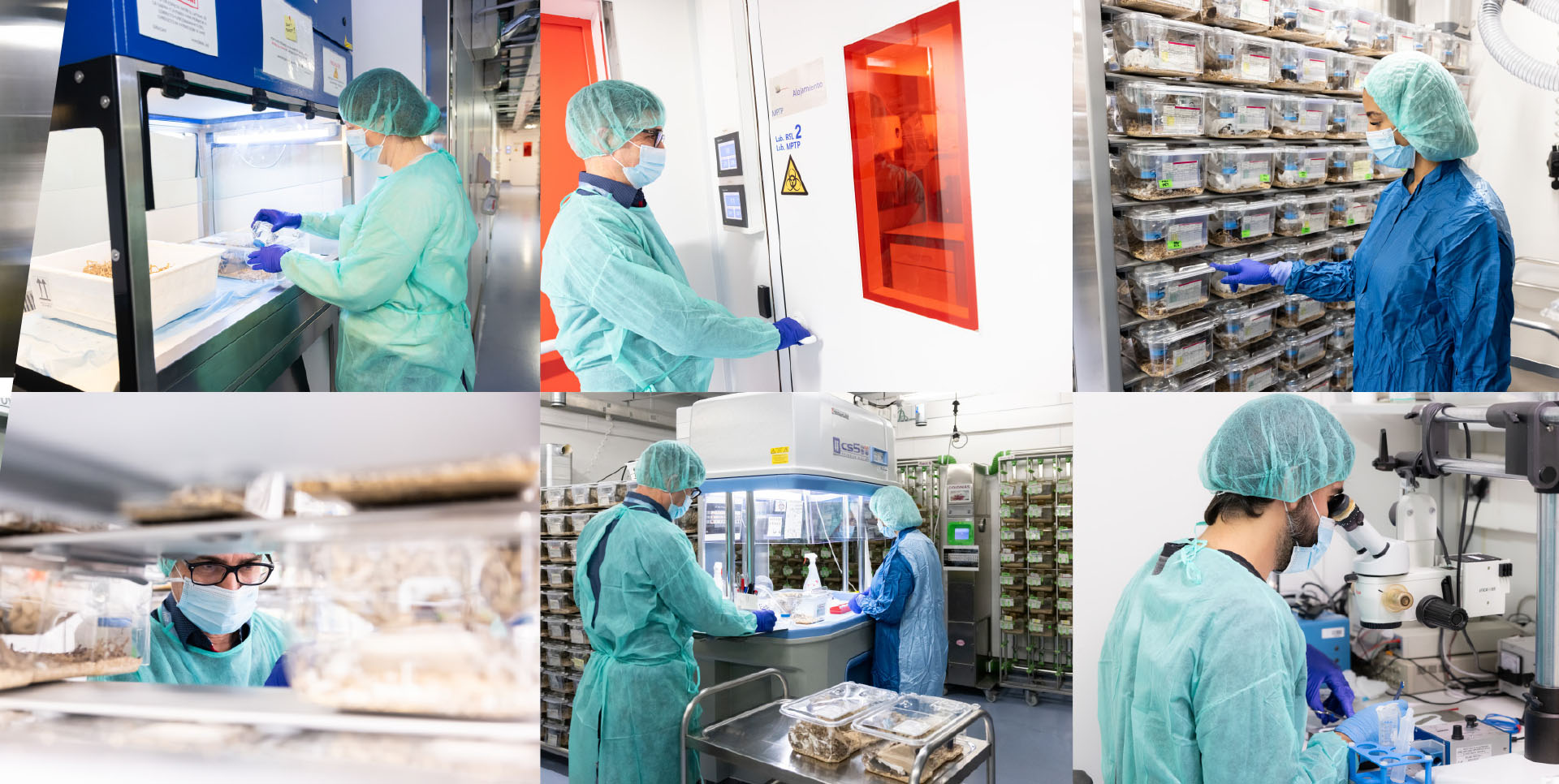
Laboratory rodents used for research and teaching purposes are centralized at the Laboratory Animal Service (LAS), located at CELLEX and managed by VHIO. Established in 2015, the LAS is a cutting-edge, shared facility across the Vall d’Hebron Barcelona Hospital Campus. Spanning a total surface area of 1347 m2, it has 4,347 mouse cages and 245 rat cages, and 16 equipped laboratories (202 m2).
Equipment and facilities:
The LAS is divided up into seven experimental areas, as well as those dedicated to technical material-sterilization and management, administration, refrigeration storage, and type III and IV waste areas. All these areas are situated on the two underground floors, enabling experimental procedures to be conducted under strict biosafety—specific-pathogen free (SPF), conventional, non-SPF (quarantine) and biosafety level 2 (BSL2)—and microbiological conditions.
It also has a preclinical imaging platform (PIP) with rodent-dedicated optical, micro-tomographic, micro-ultrasound, histotripsy, single-photon emission computed tomography (SPECT) and positron-emission (PET CT) imaging systems.
The LAS is distributed across the following areas:
- Conventional areas 1 and 2 (CNV). Located on two floors, with a total of eight handling rooms for carrying out experimental procedures and performing surgery (equipped with oxygen, vacuum and CO2 supplies, inhalation anaesthesia equipment, biosafety hoods and surgical microscopes), and five rooms housing mice (4 rooms) and rats (1 room).
- Quarantine areas (x2) and BSL2 (x2), each equipped with a housing room and an experimental room. These rooms include state-of-the-art micro-isolators and cutting-edge equipment for carrying out experimental procedures.
- SPF barrier area for immunodeficient and immunocompetent mice breeding cohorts. Two rooms equipped with absolute filters, a specific access changing-room, sterile access system (SAS) for the sterile facility entrance, steam autoclave and Hydrogen Peroxide SAS both with double door for sterilizing food, absorbent materials, cages and accessories, and locally produced sterile water. It also has handling rooms equipped with oxygen, vacuum and CO2 supplies, and inhalation anaesthesia equipment.
- Service and corridor areas. Cleaning area with feeding bottle washers, material decontamination SAS, autoclave, clean material storage, a cage-preparation room and general storage.
Key Objectives:
- Regulatory Excellence: Ensuring full compliance with EU and local regulations regarding the use of animals in scientific research.
- Ethical Commitment: Strict adherence to the principles of the 3Rs (Replacement, Reduction, Refinement) and the Confederation of Scientific Societies of Spain’s (COSCE) Transparency Agreement.
- Animal Welfare: Providing high-standard housing and rigorous health surveillance to ensure animal well-being and the reproducibility of scientific data.
- Scientific Support: Offering expert technical and scientific consultancy on animal modeling and specialized equipment.
- On-Demand Services: Providing tailored experimental support to meet specific investigator needs.
Team
Directed by Albert Altafaj Tardío, the Laboratory Animal Service (LAS) comprises a designated veterinary surgeon, experts specialized in rodent-colony management and experimental models, a dedicated team of preclinical imaging experts, care staff as well as technical area personnel (support and cleaning).
Projects
Agreement to consolidate, develop, give continuity and regulate the actions in scientific-technological infrastructures of the CERCA system and continue with the development and management of the access platform to them, CERCA-GINYS.