
Management

Carles Constante
Managing Director
Academic Qualifications
- 2013 – Healthcare Management Program. Executive Education. IESE Business School
- 2011 – Innovation and leadership strategies for public governance. IESE Business School
- 1992-1993 – Directorate of Health Care Institutions. IESE
- 1988-1989 – Diploma in Hospital Management from the School of Business Administration (ESADE)
- 1983 – Degree in Medicine and Surgery
- 1975-1981 – Degree in Medicine and Surgery
Professional Experience
- 2016-2022 – General Director of the Integral Health Consortium (CSI)
- 2013-2016 – Director General of Health Planning and Research of the Department of Health of the Generalitat de Catalunya
- Chairman of the Board of Directors of the Catalan Institute of Health (ICS)
- Chairman of the Board of Directors of the Institute of Diagnostic Imaging (IDI)
- 2011-2013 – General Director of the General Directorate of Regulation, Planning and Health Resources of the Department of Health of the Generalitat de Catalunya
- 2011 – Manager of the Barcelona Sud Territorial Area of the Catalan Health Service
- April 2009-October 2010 – Director General of the Andorran Health Care Service (SAAS), together with the role of the Health Care Directorate
- July 2007-October 2008 – Manager of the Sant Antoni Abat Regional Hospital Foundation, Manager of the Sant Antoni Abat Rehabilitation Center and Manager of the Consortium of Services to People in Vilanova i la Geltrú
- 2005-2007 – Project Manager. Consorci Hospitalari de Catalunya, CHC Consultoria i Gestió, S.A.
- 2004-2005 – Care Director of the Pere Virgili Health Park (Barcelona). CHC Consulting and Management, S.A.
- 2002-2004 – President and CEO of the Integral Health Consortium
- 2000-2002 – President and CEO of the Red Cross Health Consortium in Catalonia.
- Consorci Sanitari de la Creu Roja a Catalunya is the name prior to that of Consorci Sanitari Integral, and the activities have been included in the section dedicated to it.
- 1996-2000 – Director of the Health Area of the Catalan Health Service (SCS).
- 1995-1996 – Head of the Hospitals Division of the Catalan Health Service
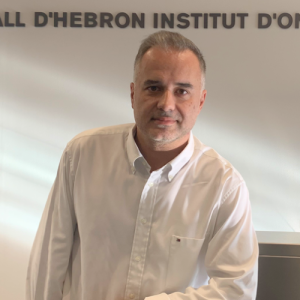
Sergi Cuadrado
Deputy Managing Director
Deputy Management supports VHIO’s Directorate and Managing Director in planning, coordinating and developing the institutional strategy, helping translate the Institute’s strategic objectives into organisational management and operations.
Its main responsibilities include coordinating management and support areas across the organisation, monitoring strategic plans and projects, promoting organisational transformation and improvement initiatives, and supporting decision-making by the Directorate and the governing bodies, of which it is a member.
It also participates in developing institutional partnerships and projects and coordinating with organisations within the Vall d’Hebron Campus and other collaborating bodies and institutions, with the aim of supporting VHIO’s sustainable growth and creating the conditions needed to fulfil its scientific mission.
VHIO has specialised functional areas that provide research support services, including:
Finance and Administration Area

Laura Delgado
Director
The Finance and Administration Area provides the economic, financial and administrative support needed for VHIO’s research activities to meet the highest standards of rigour, efficiency and transparency.
Its mission is to ensure the Foundation’s financial sustainability through responsible resource management. To this end, it provides reliable financial information to support decision-making, ensures compliance with legal obligations and funders’ requirements, and promotes the continuous improvement of processes and information systems.
The area comprises three specialised units that work together to support the Directorate, research staff and the organisation as a whole.

Ángeles Milán Ferri
Coordinator
The Finance Unit is responsible for the Foundation’s financial management. Its responsibilities include budget planning and control, accounting, treasury management, invoicing, purchasing, and compliance with tax, accounting and corporate obligations.
It also provides the financial information needed for decision-making and ensures efficient and transparent resource management.

Mariona Pons
Coordinator
The Post-Award Finance Unit is responsible for the financial management of research projects once funding has been awarded.
The unit supports research teams in managing funded projects’ finances throughout their lifecycle. It also monitors budgets, ensures compliance with funders’ requirements and guarantees accurate financial reporting and justification of expenditure.

Eric Rufas Ferrer
Coordinator
The Information Systems and Processes Unit drives digital transformation in financial management through the development and integration of information systems, process automation and the implementation of technological solutions.
The unit helps improve operational efficiency, optimise management processes and strengthen information quality and reliability.
Business Development, Innovation, and Information Systems and Technology Area

Carlos López
Director
The mission of the Business Development, Innovation, and Information Systems and Technology Area is to connect VHIO’s research activities with the partner organisations, sponsors and technologies that make them possible.
The department comprises five units responsible for negotiating, legally reviewing and managing research agreements and contracts with public and private organisations; negotiating the financial terms of clinical trials; managing VHIO’s intellectual and industrial property and supporting spin-off creation; managing information systems and technology; and managing advanced technology platforms.
Together, these units work to translate scientific opportunities into effective agreements, protect the Institute’s assets, ensure data security and provide research staff with the technologies needed to carry out their work.

Mario De la Cuesta Rivero
Coordinator
The Innovation Unit identifies, evaluates and develops the value of innovative projects generated at VHIO, actively manages the Institute’s industrial property portfolio and secures the public and private funding needed to advance their development.
The unit promotes a culture of innovation and entrepreneurship and establishes strategic partnerships with companies and stakeholders in the innovation ecosystem to support the development and commercialisation of VHIO’s portfolio of innovative projects. It also leads the creation of Institute spin-offs and monitors their subsequent development.
Yasmina Bernabé
Coordinator
The Clinical Trial Budgets and Contracts Unit manages contracting for VHIO’s clinical trials, covering all stages of financial negotiations and liaison with the contract management teams of sponsors and contract research organisations (CROs).
The unit coordinates internal activities relating to the review of clinical trial fees, the definition and updating of billable items, and the management of the terms and collaboration agreements needed to conduct trials, both within VHIO and with external organisations. It works closely with the Clinical Research Unit and the Institute’s financial management team to ensure that the agreed terms are correctly applied throughout each study.

Marina Alonso Pujol
Coordinator
The Legal Affairs and Compliance Unit manages, negotiates and reviews the agreements governing VHIO’s collaborations, including confidentiality, material transfer, service provision, collaboration, consortium and data-related agreements, among others.
The unit also oversees compliance with the regulatory frameworks applicable to the Institute’s activities and provides legal advice across the organisation, ensuring that all contracts and agreements comply with current legislation and align with VHIO’s strategic objectives.
Alfred Gutierrez Sanmiguel
Coordinator
The unit provides and maintains the technological infrastructure underpinning VHIO’s research activities. It designs the Institute’s information systems architecture and implements the resources and tools needed to ensure the integrity, security, confidentiality and availability of the data and research results generated at the centre.
Its main activities include implementing and maintaining computing and data storage platforms; deploying collaborative environments that facilitate efficient research project management; ensuring the reliable operation of data collection and analysis platforms; and identifying, prioritising and adopting emerging technologies that contribute to the continuous improvement of VHIO’s information systems.
The unit provides VHIO’s research groups with access to advanced microscopy, flow cytometry and cell sorting instrumentation. These technologies enable detailed studies of tumour cells and generate evidence supporting advances in translational research.
The unit promotes the use of its platforms, trains users in the correct operation of equipment and provides scientific and technical support to research groups, from experimental design through to obtaining results.
General Services and Infrastructure Area (SGI)

Sergi Simon
Director
The mission of the General Services and Infrastructure Area (SGI) is to ensure that spaces, facilities, equipment and services meet the centre’s translational research and organisational needs safely, efficiently and sustainably.
The area comprises four units that work to ensure the smooth day-to-day operation of infrastructure, maintain its safety and adapt it to the new requirements of a constantly evolving environment.
Across all units, shared responsibilities include managing processes and their documentation, contracting and suppliers, financial information, indicators, audits and service levels, management applications and administrative support.

Nuria Colomé
Coordinator
The unit’s main objectives are to manage technical support to ensure the proper functioning of scientific research and clinical equipment; ensure the supply of laboratory materials and solutions; organise and coordinate training activities; and provide and maintain functional workspaces.
To achieve these objectives, the unit has its own staff, who also coordinate and manage the Preparation Room, staffed by VHIO personnel, and the Biomedical Engineering Service, provided by specialised external personnel.
Helena Gallego Sanz
Coordinator
The unit’s main objectives are to ensure the proper functioning and availability of facilities and technical systems; maintain the quality and continuity of general services; address incidents arising from day-to-day operations; and manage spaces and their continuous improvement through targeted interventions to adapt them to the organisation’s needs.
To achieve these objectives, the unit has its own staff responsible for managing and coordinating the different services, primarily provided by specialised external companies, and ensuring their monitoring and adaptation to VHIO’s needs.
The unit’s main objectives are to ensure the safety of people and infrastructure through emergency preparedness, the prevention of risks arising from infrastructure and facilities, and biosafety, as well as monitoring safety and security incidents.
To achieve these objectives, the unit has its own staff who manage and coordinate prevention and safety activities.
The unit’s main objectives are to plan and manage infrastructure construction, refurbishment and adaptation projects, and to provide technical and regulatory support and advice to address new requirements for spaces and facilities.
To achieve these objectives, the unit has its own staff who manage projects with support from external engineering consultancies.
People Area
The mission of the People Area is to attract, develop and support the people who make up VHIO’s scientific and professional community, promoting an excellent, inclusive working environment aligned with European research standards.
Its structure combines administrative and employee relations management with a strategic approach to talent development. The area is organised into two complementary units that work together to provide comprehensive people management. The units collaborate to ensure compliance with employment legislation and promote a development model based on excellence, transparency and continuous improvement.
Commitment to Excellence in People Management
As an institution committed to research excellence, VHIO actively participates in the European Commission’s Human Resources Strategy for Researchers (HRS4R) and holds the HR Excellence in Research recognition.
This commitment involves incorporating the principles of the European Charter for Researchers and the Code of Conduct for the Recruitment of Researchers into its people management policies.
Within this framework, the People Area leads the implementation of policies aimed at:
- Ensuring open, transparent and merit-based recruitment processes, in accordance with OTM-R principles.
- Supporting the professional development and continuous training of all staff.
- Promoting equal opportunities, diversity and inclusion.
- Driving wellbeing and work–life balance initiatives that help create a healthy working environment.
- Strengthening an organisational culture based on collaboration, innovation and scientific excellence.
The area’s objective is to consolidate a people management model that attracts, develops and retains talent, enabling researchers and other professionals across the organisation to fulfil their potential and contribute to advances in cancer research.
Vanessa Manzano
Head
The Employee Relations Unit is responsible for personnel administration, employment contracts, payroll management and compliance with employment legislation.
It also manages employee relations and provides advice in this field, as well as coordinating activities related to occupational risk prevention.

Anna Galera Urrea
Head
The Talent and Development Unit drives talent management policies throughout the professional lifecycle of the people who work at VHIO.
Its activities focus on attracting, developing, recognising and retaining talent, as well as promoting an organisational culture based on excellence, collaboration and continuous learning.
Quality Area

Gemma Sala
Director
The mission of the Quality Area is to ensure excellence and continuous improvement in VHIO’s activities through the implementation, maintenance and oversight of its Quality Management System.
Its responsibilities include standardising and optimising processes; ensuring compliance with Good Clinical Practice and regulatory and quality requirements; conducting audits and internal checks; managing ISO certifications; developing standard operating procedures; and promoting a culture of quality through continuous training. All these activities aim to ensure patients’ safety and wellbeing, as well as the quality and reliability of VHIO’s clinical, translational and laboratory research activities.

Performance Indicators Management and Technical Secretariat Unit

Marc Navarro
Head
The Performance Indicators Management and Technical Secretariat Unit provides strategic support to the Managing Director in planning, monitoring and evaluating the institutional strategy. Its mission is to centralise, analyse and transform key information into useful knowledge to support data-driven decision-making, and to coordinate the development, implementation and updating of the Strategic Plan and other planning tools.
Its main responsibilities include managing and monitoring the Balanced Scorecard and key performance indicators (KPIs), ensuring the quality, consistency and traceability of information in collaboration with the different areas. It also coordinates institutional requests for indicators, establishes consistent criteria and develops monitoring systems, executive reports and visualisation tools to assess progress towards objectives and identify potential deviations, risks and opportunities for improvement.
As the Technical Secretariat, it monitors actions arising from institutional evaluation, accreditation, audit and review processes, ensuring that recommendations and improvement plans are implemented. In this way, the unit helps strengthen transparency, continuous improvement and evidence-based institutional management.