
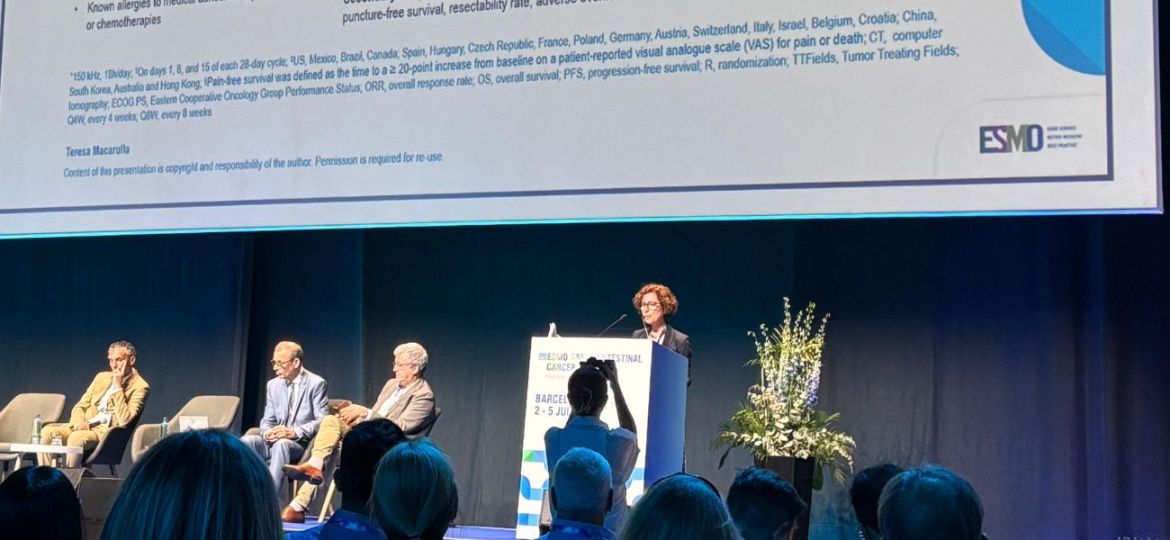
The ESMO GI 2025 Congress brought together specialists from around the world in Barcelona from July 2 to 5 to explore the latest developments in the treatment and research of digestive cancers.
The programme featured scientific presentations, debate sessions, and opportunities to share clinical experience, with a strong focus on precision medicine, early diagnosis, and patient-centered approaches.
Among the scientific chairs of the congress was Dr. Teresa Macarulla, medical oncologist at Vall d’Hebron University Hospital and head of the Upper GI and Endocrine Tumours Group at VHIO, reinforcing the institution’s position as a leading reference in GI oncology.
PANOVA-3 Study – Quality of Life Results
Dr. Teresa Macarulla presented the quality-of-life results from the PANOVA-3 study, which evaluates adding Tumor Treating Fields (TTFields) to gemcitabine and nab-paclitaxel in patients with locally advanced, unresectable pancreatic adenocarcinoma. Positive data on overall survival, pain-free survival, and metastasis-free survival were previously presented at ASCO. This congress focused on patient quality of life.
“A significant improvement in overall survival and a delay in pain progression and opioid use was observed in patients treated with TTFields and chemotherapy versus chemotherapy alone,” said Dr. Macarulla. “Pancreatic cancer is often accompanied by severe pain, so delaying symptoms can help preserve quality of life. These promising results support TTFields with gemcitabine and nab-paclitaxel as a potential new standard for locally advanced unresectable pancreatic cancer.”
Immunotherapy combination improves quality of life in metastatic colorectal cancer
Dr. Elena Élez, medical oncologist at Vall d’Hebron University Hospital and head of the Colorectal Cancer Group at VHIO, presented quality-of-life results from the CheckMate 8HW study, comparing nivolumab plus ipilimumab versus nivolumab alone in patients with MSI-H/dMMR metastatic colorectal cancer.
“NIVO + IPI showed improved health-related quality of life (HRQoL) and symptom reduction from baseline,” said Dr. Élez. “Adding IPI significantly improved progression-free survival compared to NIVO monotherapy without compromising quality of life.”
MSI-H/dMMR subtypes, marked by microsatellite instability or DNA repair deficiency, account for 5–7% of new metastatic CRC diagnoses.
At this year’s ASCO GI congress, data showed that this combination activates the immune system more effectively than monotherapy. At ESMO GI, early first-line results comparing this combination to nivolumab alone were also presented.
A promising bispecific antibody in colorectal cancer
Dr. Élez also presented results for invikafusp, a first-in-class bispecific antibody designed to selectively activate T-cell subpopulations with TCR Vβ6 and Vβ10 receptors.
In the phase 1/2 STARt-001 trial, invikafusp alfa showed promising monotherapy activity in advanced solid tumors resistant to checkpoint inhibitors. Based on these results, the FDA granted accelerated approval in January 2025 for unresectable or locally advanced TMB-H metastatic colorectal cancer. At ESMO GI, new data on invikafusp in antigen-rich GI tumors was presented.
“This novel antibody demonstrated clinically meaningful antitumor activity in several GI cancers, especially colorectal. The phase 2 expansion continues in antigen-rich GI tumors to further evaluate its efficacy,” said Dr. Élez.
VHIO researchers also presented various studies as scientific posters:
- Real-world outcomes of anti-EGFR rechallenge in RAS/BRAF wt mCRC – Pau Mascaró
- Prognostic impact of weight loss on OS in mCRC: integrating nutritional care – Adriana Alcaraz
- Prognostic impact of weight loss on OS in mCRC – Javier Ros
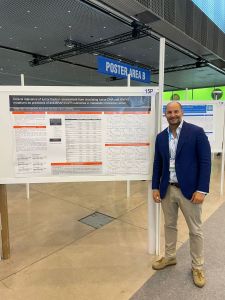
- Relevance of ctDNA tumor fraction and RNF43 mutations as predictors of anti-BRAF/EGFR outcomes – Rodrigo Toledo
-
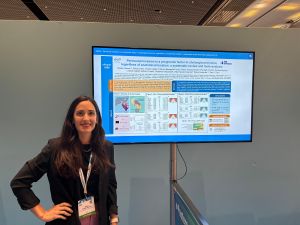
Perineural invasion is a prognostic factor in cholangiocarcinoma, regardless of anatomical location: A systematic review and meta-analysis – Natalia Tissera
-
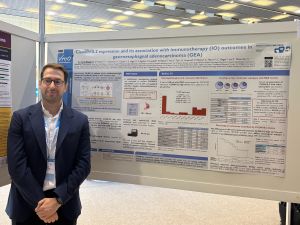
Claudin18.2 expression and its association with immunotherapy outcomes in gastroesophageal adenocarcinoma – Eduardo Teran