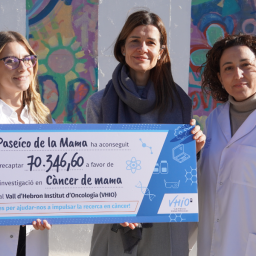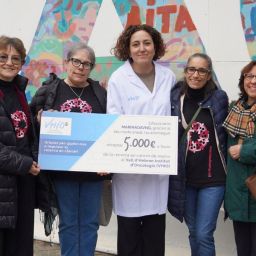

The Nocturna Rosa Association of Malgrat is a non-profit organization that is dedicated, since 2010, to the organization of solidarity actions to raise funds for the medical oncological research, especially for the research of children’s cancer and breast cancer.
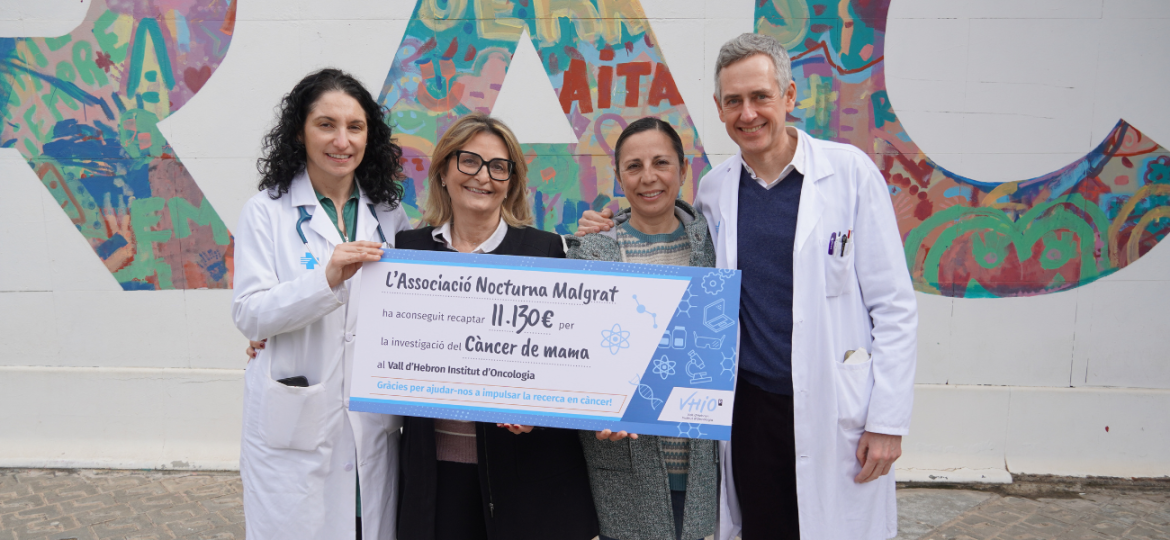
La Nocturna Rosa has grown over the last few years and at the III Nocturna Rosa Solidarity Dinner, which was held last October, 11.130€ was raised for the VHIO’s Breast Cancer Group. The event was attended by more than 300 people and companies committed to research into this disease.
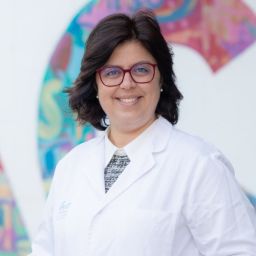
This year, the funds raised will go to VHIO’s breast cancer research, specifically to the ADDAPTING project led by Dr. Meritxell Bellet, medical oncologist and member of VHIO’s Breast Cancer Group.
ADDAPTING, A PROJECT TO DECIDE WHICH PATIENTS SHOULD RECEIVE CHEMOTHERAPY AND WHICH PATIENTS CAN AVOID CHEMOTHERAPY
Luminal breast cancer is a subtype of breast cancer that is classified according to the presence of hormone receptors and the expression of certain proteins. It is considered a hormone-sensitive cancer, the type of cancer that responds well to hormonal treatments.
The ADDAPTING project focuses on patients with early breast cancer, with HER2 hormone receptors (RH+ HER2-), who have certain risk parameters, either because of their more aggressive biology (e.g. more proliferative, i.e. with a higher proportion of dividing cells, and/or with low expression of the progesterone receptor); or, conversely, because of their more indolent biology, i.e. slower growing, but with larger tumours at diagnosis, or even with 1 to 3 axillary nodes involved.
The standard treatment in any case for these tumours is chemotherapy, preferably preoperatively in larger tumours. However, we know from previous studies (ADAPT study) that we can identify patients who have a good prognosis without chemotherapy.
The ADDAPTING project aims to use gene platforms in the diagnostic biopsy, prior to surgery, and then perform a hormone therapy sensitivity test consisting of 3-4 weeks of endocrine treatment. After this treatment, an assessment is made of how the individual patient’s tumour has performed in terms of decreased proliferation rate in a new tumour sample.
In tumours with intermediate risk as determined by the gene platform in the initial biopsy or premenopausal women with a positive node, where the indication for chemotherapy is uncertain, the substantial drop in the second proliferation after endocrine treatment gives us very useful information to discourage chemotherapy treatment.
The ADDAPTING study uses this strategy and, with more clinical experience, and with the help of molecular studies, we hope to individualise systemic treatment decisions (chemotherapy or not, cyclin inhibitors or not…) in these early phases where the intention is curative.
Dr. Meritxell Bellet explains: “The results extracted from these gene platforms, plus the results after administering hormone treatments to patients for one month, will make it possible to decide more precisely which patients can avoid chemotherapy or who should receive it”.
This treatment strategy is particularly useful in pre-menopausal patients and in older patients with more aggressive luminal tumours. Specifically, at Vall d’Hebron University Hospital, in collaboration with the VHIO Breast Cancer Group, 26 patients have already been treated as part of the ADDAPTING project and the first, highly satisfactory results are to be published in ESMO Breast 2025.
LA NOCTURNA ROSA, AN INITIATIVE THAT HAS FUNDED MULTIPLE RESEARCH PROJECTS
In the last two years, the Nocturna Rosa initiative has financed the research project on Mechanisms of resistance to anti-HER2 therapies in patients with HER2-positive metastatic breast cancer, led by Dr. Santiago Escrivá, medical oncologist and member of the VHIO Breast Cancer Group.
Thanks to these contributions, plasma and tumour tissue samples from patients with HER2-positive metastatic breast cancer have been studied before the start of treatment to see if they had genetic mutations associated with breast cancer by comparing them with two known breast cancer mutation panels developed at VHIO, VHIO-300 and Guardant360, in tissue and plasma respectively.
In addition, liquid biopsy samples have been collected from these patients before each treatment, to subsequently investigate the mechanisms of resistance to targeted therapies, assess genomic results and look for possible DNA changes in these patients.
Dr. Santiago Escrivá comments: ‘The Nocturna Rosa initiative has helped us to carry out genomic analysis of these samples and has allowed us to obtain very valuable results for the project’.