
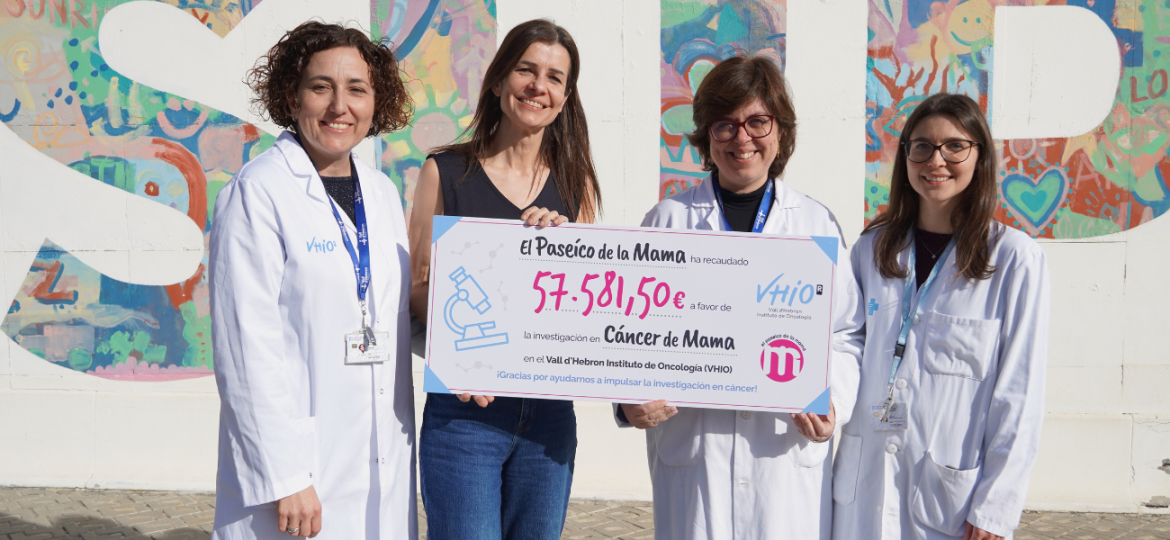
On 13 January, Inés Gasén, organiser of El Paseíco de la Mama, visited VHIO to present the funds raised in the latest edition of this solidarity initiative. This took place on 27 September in Zaragoza.
This walk forms part of a well-established initiative that has supported multiple research projects led by VHIO’s Breast Cancer Group over the past fifteen years.
El Paseíco de la Mama was founded in 2011, when Elaine Robinson, following the diagnosis of breast cancer in her daughter-in-law, Inés Gasén, organised a walk along the Zaragoza canal to raise funds for research into this disease.
Fifteen years after its first edition, El Paseíco de la Mama has become an essential annual event thanks to the commitment and involvement of Zaragoza citizens. Managed jointly by Inés and Elaine, the initiative brings together hundreds of participants each year. These participants participate in the walk and contribute to breast cancer research.
Inés Gasén commented: “We are very happy to present this donation, and we will continue to support VHIO through this initiative in any way we can.”
Dr Cristina Saura, Head of the Breast Cancer Unit at Vall d’Hebron University Hospital and of VHIO’s Breast Cancer Group, together with Dr Vittoria Barberi, medical oncologist at Vall d’Hebron University Hospital and researcher within the Breast Cancer Group, attended the cheque presentation.
“For the Breast Cancer Group, it is an honour to receive the continued support of El Paseíco de la Mama. Thanks to this donation we can continue moving forward,” explained Dr Saura.
The donation, amounting to more than 57.000€, was received by Dr Mafalda Oliveira, medical oncologist at Vall d’Hebron University Hospital, senior investigator in VHIO’s Breast Cancer Group and leader of the PORTRAIT-TNBC project. The full amount will be allocated to this research initiative.
The PORTRAIT-TNBC project analyses immune system signals that predict treatment response in breast cancer
The PORTRAIT-TNBC project aims to identify which patients with early triple-negative breast cancer (eTNBC) are most likely to benefit from a treatment combining chemotherapy and immunotherapy.
Triple-negative breast cancer affects approximately one in ten women with localised breast cancer. Although it is generally considered the most aggressive subtype, significant advances have been achieved in recent years. These advances include the combination of chemotherapy with the immunotherapy drug pembrolizumab.
The PORTRAIT-TNBC project seeks to determine which patients require this drug and which do not, avoiding unnecessary treatment exposure. To this end, the study will investigate why treatment responses differ by analysing immune system cells (T lymphocytes) in blood and tumour tissue samples collected before and during treatment. The objective is to identify immune signals that predict treatment response and side effects.
These findings will enable more personalized treatment strategies, including avoiding unnecessary therapies in some cases or reducing treatment duration in patients with excellent responses. Ultimately, the goal is to improve treatment tolerability and positively impact patients’ quality of life without compromising their chances of cure.
Dr Oliveira explains: “In the future, the aim of the PORTRAIT-TNBC project is that, based on these results, oncology teams at any hospital will have access to a tool that helps them make rapid, personalised decisions, with the goal of selecting the most appropriate treatment for each patient.”
Thanks to the funds raised through this fifteenth edition of El Paseíco de la Mama, this research will be able to continue making decisive progress towards more individualised care. This will be done by translating laboratory findings into clinical practice and improving therapeutic options for this group of patients.
Thank you for 15 years of commitment and solidarity to breast cancer research.