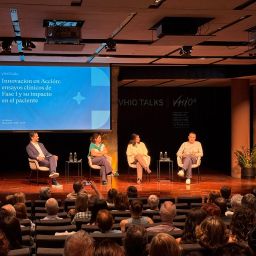

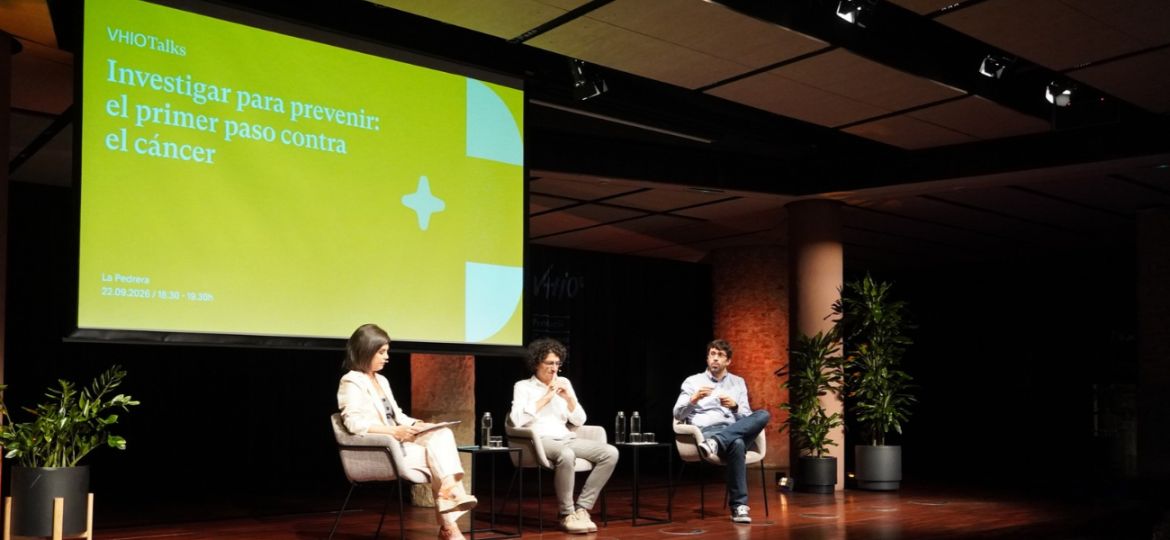
On 22 September, Casa Milà – La Pedrera hosted the fourth session of VHIO Talks 2026, dedicated to “Research to prevent: the first step against cancer”. The series is being held as part of the 20th anniversary of the Vall d’Hebron Institute of Oncology (VHIO), in collaboration with Fundació Catalunya La Pedrera.
The discussion brought together Dr Marcos Malumbres, Head of VHIO’s Cell Cycle and Cancer Group, and Dr José A. Seoane, Head of VHIO’s Computational Cancer Biology Group, with journalist Samantha Villar as moderator.
Prevention is gaining prominence in cancer research
Both researchers are involved in cancer prevention projects and agreed that there is still much to learn about how lifestyle habits and environmental exposures influence the development of cancer. “There is a great deal of work to be done to gather evidence about which aspects of the way we live contribute to disease,” said Dr Malumbres. Collecting and analysing reliable data is essential to making progress in this field and helping people make informed decisions.
One challenge is obtaining that information. “Much of what we know about a person’s habits and exposures comes from asking them directly. However, their answers do not always allow us to reconstruct accurately what happened over an entire lifetime,” explained Dr Seoane. That is why researchers are exploring new ways to study these exposures. Some can leave biological traces in cells or tumours that offer clues about what a person has experienced. Interpreting these traces requires rigorous methods and enough samples to distinguish consistent signals from coincidences.
Studying small cell lung cancer from different angles
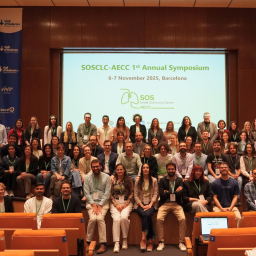
During the talk, Dr Marcos Malumbres presented the SOSCLC–AECC project, which he co-leads with Dr Luis Paz-Ares of Madrid’s Hospital 12 de Octubre. Awarded €10 million in funding by the Spanish Association Against Cancer in 2024, it is one of Spain’s largest research projects on small cell lung cancer. It brings together 330 researchers to study the disease and seek ways to improve its prevention, diagnosis and treatment.
“95% of people with this type of cancer are smokers. The link with this exposure is so clear that it makes this an interesting model for studying prevention,” Malumbres explained. To this end, the project combines molecular analysis of the disease with information on lifestyle habits and possible environmental exposures. Researchers collect different types of samples, from saliva to toenails, as well as data provided by participants.
Studying all this information could help identify new risk factors and find biomarkers that enable earlier detection of the disease. In the longer term, it could also help researchers better understand who is at greater risk of developing it.
Reading traces of environmental exposures in tumours
Dr José A. Seoane presented a study recently published in Nature Medicine that began with a question arising from clinical observation: why are more and more cases of colorectal cancer being diagnosed in people under 50?
“We wanted to know what differences there were between the tumours of people under and over 50, but when we studied DNA mutations, there were not enough differences… there had to be something else,” Seoane explained. The team found that the key could lie in studying epigenetics: marks on DNA that regulate gene activity.
The study identified epigenetic traces in tumours associated with known factors, such as smoking and diet, but also a more unexpected association with a signature linked to the herbicide picloram.
Seoane stressed that identifying an association does not mean proving a cause. “The next step would be to carry out experiments in cell or animal models: expose them to the possible factors involved and study whether the occurrence of tumours increases,” he explained. These studies would help establish what role such exposures may play in the development of cancer.
Collaborative, multidisciplinary research
The session ended with a shared conclusion: researching prevention requires bringing together knowledge from different disciplines and collecting data from many people and settings.
“Networks like the one in this project are essential. We are trying to solve big problems, and we cannot do that through a series of small projects. We need a large one that involves everyone,” said Malumbres, referring to the small cell lung cancer consortium.
Seoane noted that this collaboration also takes place among VHIO’s groups: “We work closely together. The picloram project grew out of a task force. This is essential to moving faster and in the right direction.”