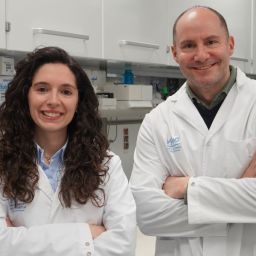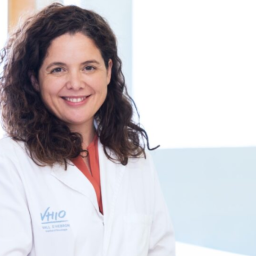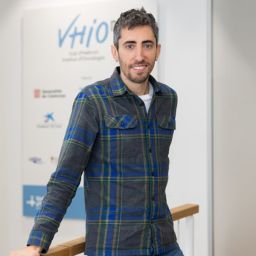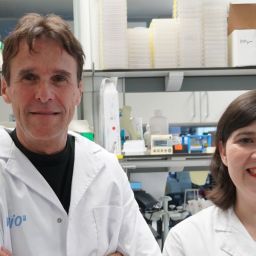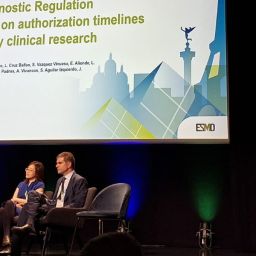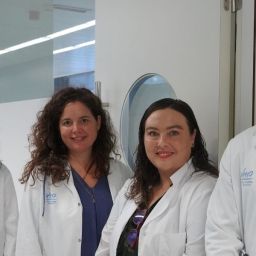


- Reported at the European Society for Medical Oncology (ESMO) Congress 2025 in Berlin, Germany, results from four multicenter early phase clinical studies—co-conducted at VHIO’s Research Unit for Molecular Therapy of Cancer (UITM) – CaixaResearch—show promising advances in the targeted treatment of solid tumors, from innovative bispecific antibodies to novel therapies with more potent and selective mechanisms of action.
Presented at the ESMO Congress 2025, 17 – 21 October in Berlin, four international multicenter studies, co-led by VHIO’s Research Unit for Molecular Therapy of Cancer (UITM) – CaixaResearch, show promise in advancing investigational therapies across a range of solid tumors.
“Phase I clinical trials in oncology have rapidly evolved over the past several years,” said Elena Garralda, Medical Oncologist at the Vall d’Hebron University Hospital, Director of the UITM – CaixaResearch, and Head of VHIO’s Early Clinical Drug Development Group, “and now early phase units including our UITM – CaixaResearch have become innovative hubs for the early clinical drug development of novel, potentially more potent anti-cancer therapies with new mechanisms of action, or that attack new therapeutic targets, representing a new window of opportunity for our patients.”
INCA33890, a promising TGFβR2×PD-1-directed bispecific antibody
In the Mini oral session: Investigational immunotherapy on Friday, October 171, Elena Garralda presented findings from the first-in-human, open-label, multicenter study evaluating the safety and efficacy of INCA33890 anti-PD-1/ TGFβR2 bispecific antibody in patients with advanced solid tumors that had progressed on standard treatment including immune checkpoint inhibitors (ICIs). In total this study included 260 patients, with colorectal cancer being the most frequent tumor type, accounting for 150 patients. This novel bispecific antibody is designed to bind to a patient’s immune cells and block two molecules, TGFβR2 and PD-1, to boost the patient’s own immune response to attack cancer cells.
The investigators observed an objective response rate of 15.2% with a median duration of response of 7.3 months, increasing up to 40% in patients whose tumors had high-level PD-L1 expression. In one case of a patient with colorectal cancer with liver, bone, and lung metastases, a partial response was observed for approximately one year. The efficacy of this bispecific antibody combined with standard of care treatments is currently being assessed in patients with metastatic colorectal cancer.
Novel YAP/TAZ-TEAD disruptor demonstrates clinical efficacy
Elena Garralda also reported dose escalation data from the ongoing first-in-human study of single agent IAG933, a novel small molecule inhibitor developed to directly disrupt the YAP/TAZ-TEAD protein-protein interaction, in the Proffered paper session: Mesothelioma and thymic tumours: Targeting and breaking through on Sunday, October 192.
Novel YAP/TAZ-TEAD disruptor demonstrates clinical efficacy
Elena Garralda also reported dose escalation data from the ongoing first-in-human study of single agent IAG933, a novel small molecule inhibitor developed to directly disrupt the YAP/TAZ-TEAD protein-protein interaction, in the Proffered paper session: Mesothelioma and thymic tumours: Targeting and breaking through on Sunday, October 192.
Inhibition of YAP/TAZ-TEAD crosstalk is essential for regulating cell proliferation and tumor formation. By inhibiting this interaction, IAG933 could put the brakes on uncontrolled cell growth. This phase I, open-label, multicenter, dose escalation and expansion study of IAG933 was designed to assess the safety and tolerability, recommended dose/schedule, and antitumor activity of this inhibitor. Among the 136 patients enrolled, pleural mesothelioma was the most frequent tumor type, and the study also included patients with NF2/LATS1/LATS2-mutated solid tumors, as well as tumors with functional YAP-TAZ fusion proteins.
The investigators reported antitumor activity in patients with mesothelioma, as well as in patients with epithelial hemangioendothelioma, a rare vascular tumor, with lasting clinical benefit. This signaling pathway opens a new opportunity for targeted therapies in these types of cancer.
In addition to these two studies, Matthew G. Krebs, Clinical Senior Lecturer in Experimental Cancer Medicine at the Christie NHS Foundation Trust and Division of Cancer Sciences at the University of Manchester (UK), reported results from phase I and 2 studies of single-agent divarasib, an oral, highly potent and selective next-generation KRAS G12C inhibitor in patients with previously treated KRAS G12C-positive pancreatic adenocarcinoma, cholangiocarcinoma, and other solid tumors.
Divarasib has been shown to be between 5 and 20 times more potent and more than 50 times more selective in vitro than other current covalent KRAS-G12C inhibitors. Presented in the Mini oral session: Developmental therapeutics on Friday, October 173, and led by Elena Garralda, findings showed that divarasib demonstrated a manageable safety profile and antitumor activity across tumor types, with an overall response rate of 34.8%.
Presented by Principal Investigator Antoine Italiano, Head of the Early Phase Trials and Sarcoma Units at Institut Bergonié, Bordeaux (France), in the Mini oral session: Investigational immunotherapy on Friday October 174, the multicenter phase I/II START-001 study is a monotherapy trial evaluating invikafusp alfa, a first-in-class selective, dual T cell agonist, in patients with antigen-rich solid tumors resistant to immune checkpoint blockade (ICB).
Findings from the completed phase I START-001 dose escalation study demonstrated safety, a disease control rate of 63% and an objective response rate of 25%. First-authored by Elena Garralda, and presented as late-breaking data at ESMO 2025, initial results from the ongoing phase II dose expansion part of this study show significant antitumor activity in tumors with high mutational burden, especially in non-small cell lung cancer and colorectal cancer. These first data could open the door to a new class of immunotherapy for these patients.
###
###
References
ESMO Congress 2025, 17 – 21 October, Berlin
Corresponding session details:
Date: Fri, 17.10.2025
Chairs: Daniela S. Thommen (Amsterdam, Netherlands), Dirk Jäger (Heidelberg, Germany), Matthieu Roulleaux Dugage (Villejuif, France)
Room: Nuremberg Auditorium – Hall 5.2
Session Time: 14:00 – 15:30 (CEST)
Abstract: 1522MO – A phase I study of INCA33890, a PD-1/TGFβR2 bispecific antibody, for advanced solid tumours
Authors: Elena Garralda (Barcelona, Spain), Markus Joerger (St. Gallen, Switzerland), Martin Gutierrez (Hackensack, United States of America), Victor Moreno Garcia (Madrid, Spain), Armando Santoro (Rozzano, Italy), Sreenivasa Chandana (Grand Rapids, United States of America), Irene Moreno Candilejo (Madrid, Spain), Justin T. Moyers (Santa Monica, United States of America), Yohann Loriot (Villejuif, France), Philippe Cassier (Lyon, France), Petr Szturz (Lausanne, Switzerland), Ruth Plummer (Newcastle upon Tyne, United Kingdom), Debra Josephs (London, United Kingdom), Jordi Rodon (Houston, United States of America), Benedito A. Carneiro (Providence, United States of America), Chiara Greggio (Morges, Switzerland), Xiaohan Xu (Wilmington, United States of America), Yunlan Fang (Wilmington, United States of America), Thomas B. Karasic (Wilmington, United States of America), Filippo Guglielmo Maria De Braud (Milan, Italy)
Speaker: Elena Garralda (Barcelona, Spain)
Lecture Time: 15:05 – 15:10 (CEST)
Date: Sun, 19.10.2025
Chairs: Anastasios Stathis (Bellinzona, Switzerland), Nicolas Girard (Paris, France)
Room: Hanover Auditorium – Hall 7.2c
Session Time: 16:30 – 18:00 (CEST)
Abstract: 919O – A first-in-human study of oral IAG933 in adult patients with advanced mesothelioma and other solid tumours
Authors: Elena Garralda (Barcelona, Spain), Marie Florescu (Montreal, Canada), Joachim G. Aerts (Rotterdam, Netherlands, Noord Brabant), Tatsuya Yoshida (Chuo-ku, Japan), Sophie Postel-Vinay (Villejuif, France), Ibiayi Dagogo-Jack (Boston, United States of America), Matthew G. Krebs (Manchester, United Kingdom), Martin Metzenmacher (Essen, Germany), Thomas John (Melbourne, Australia), Hedy L. Kindler (Chicago, United States of America, IL), Mehmet Altan (Houston, United States of America), Lorenz Bankel (Zurich, Switzerland), Dale Shepard (Cleveland, United States of America), Zev A. A. Wainberg (Los Angeles, United States of America), Matteo Duca (Milan, Italy), Vincent K. Lam (Baltimore, United States of America), Katelyn Parhiala (Cambridge, United States of America), Maria-Athina Altzerinakou (Basel, Switzerland), Jason Faris (Cambridge, United States of America), Armando Santoro (Rozzano, Italy)
Speaker: Elena Garralda (Barcelona, Spain)
Lecture Time: 16:30 – 16:40 (CEST)
Date: Fri, 17.10.2025
Chairs: Fiona Thistlethwaite (Manchester, United Kingdom), Antonio Marra (Milan, Italy), Antoine Hollebecque (Villejuif, France)
Room: Heidelberg Auditorium – Hall 6.2
Session Time: 16:00 – 17:30 (CEST)
Abstract: 927MO – Single-agent divarasib experience in patients with KRAS G12C-positive pancreatic adenocarcinoma (panc), cholangiocarcinoma (cholangio), and other solid tumors
Authors: Matthew G. Krebs (Manchester, United Kingdom), Chun-Hui Lee (Tainan City, Taiwan), Eytan Ben Ami (Ramat Gan, Israel), Se Hyun Kim (Seongnam, Republic of Korea, Gyeonggi-do), Tae Won Kim (Seoul, Republic of Korea), Manish R. Patel (Fort Myers, United States of America), María Jose De Miguel (Madrid, Spain), David Thomas (Sydney, Australia), Seung T. Kim (Seoul, Republic of Korea), Takafumi Koyama (Chuo-ku, Japan), Yasutoshi Kuboki (Kashiwa, Japan), Haruyasu Murakami (Shizuoka, Japan, Shizuoka), Uma Mukherjee (London, United Kingdom), Rasha Cosman (Darlinghurst, Australia, NSW), Mitsunori Homma (Fukuoka, Japan), Siddhartha Patel (South San Francisco, United States of America), Felice Wu (South San Francisco, United States of America), Yoonha Choi (South San Francisco, United States of America), Tomi Jun (South San Francisco, United States of America), Elena Garralda (Barcelona, Spain)
Speaker: Matthew G. Krebs (Manchester, United Kingdom)
Lecture Time: 17:00 – 17:05 (CEST)
Date: Fri, 17.10.2025
Chairs: Daniela S. Thommen (Amsterdam, Netherlands), Dirk Jäger (Heidelberg, Germany), Matthieu Roulleaux Dugage (Villejuif, France)
Room: Nuremberg Auditorium – Hall 5.2
Session Time: 14:00 – 15:30 (CEST)
Abstract: LBA55 – START-001: Initial phase II clinical activity of invikafusp alfa, a first-in-class T cell receptor (TCR) β-chain-targeted bispecific antibody as monotherapy in patients with antigen-rich solid tumors resistant to immune checkpoint blockade (ICB)
Authors: Antoine Italiano (Bordeaux, France), Elena Garralda (Barcelona, Spain), Aurélien Marabelle (Villejuif, France), Claire Friedman (New York, United States of America), Ryan J. Sullivan (Boston, United States of America), Kai He (Columbus, United States of America), Nick Tschernia (Bethesda, United States of America), Alberto Hernando Calvo (Barcelona, Spain), Matthieu Roulleaux Dugage (Villejuif, France), Manuel Pedregal Trujillo (Madrid, Spain), Maria Mercedes Herrera Juarez (Toronto, Canada), Guru P. Sonpavde (Orlando, United States of America, AL), Marijo Bilusic (Miami, United States of America, PA), Ann W. Silk (Boston, United States of America), Meredith Pelster (Nashville, United States of America), Carlos A. Gomez-Roca (Toulouse, France, Haute-Garonne), Zhen Su (Cambridge, United States of America, MA), Ke Liu (Cambridge, United States of America), Lillian L. Siu (Toronto, Canada, Ontario). James Gulley (Bethesda, United States of America, MD)
Speaker: Antoine Italiano (Bordeaux, France)
Lecture Time: 15:10 – 15:15 (CEST)