
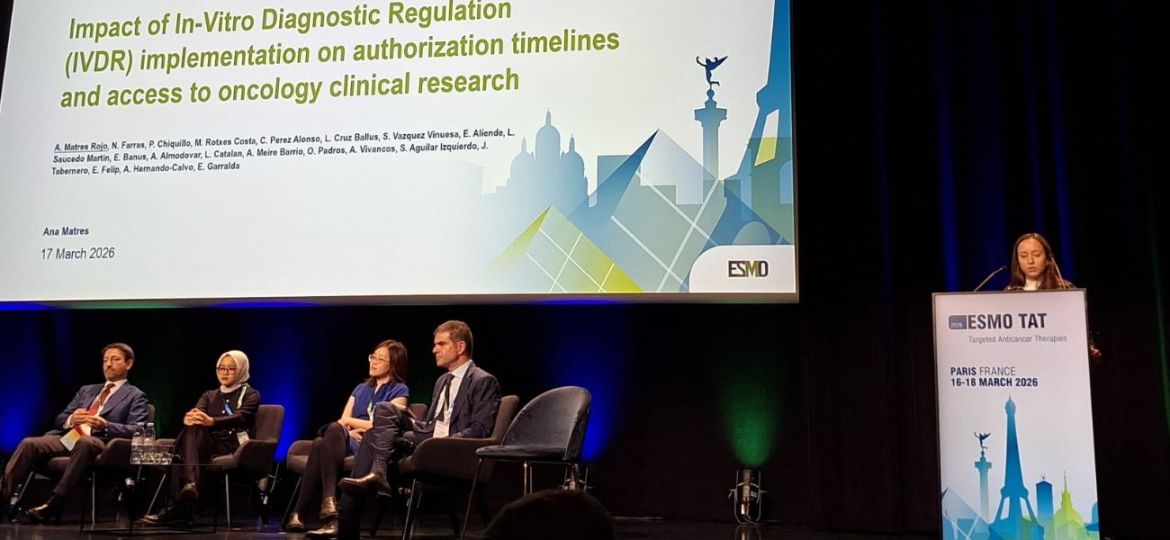
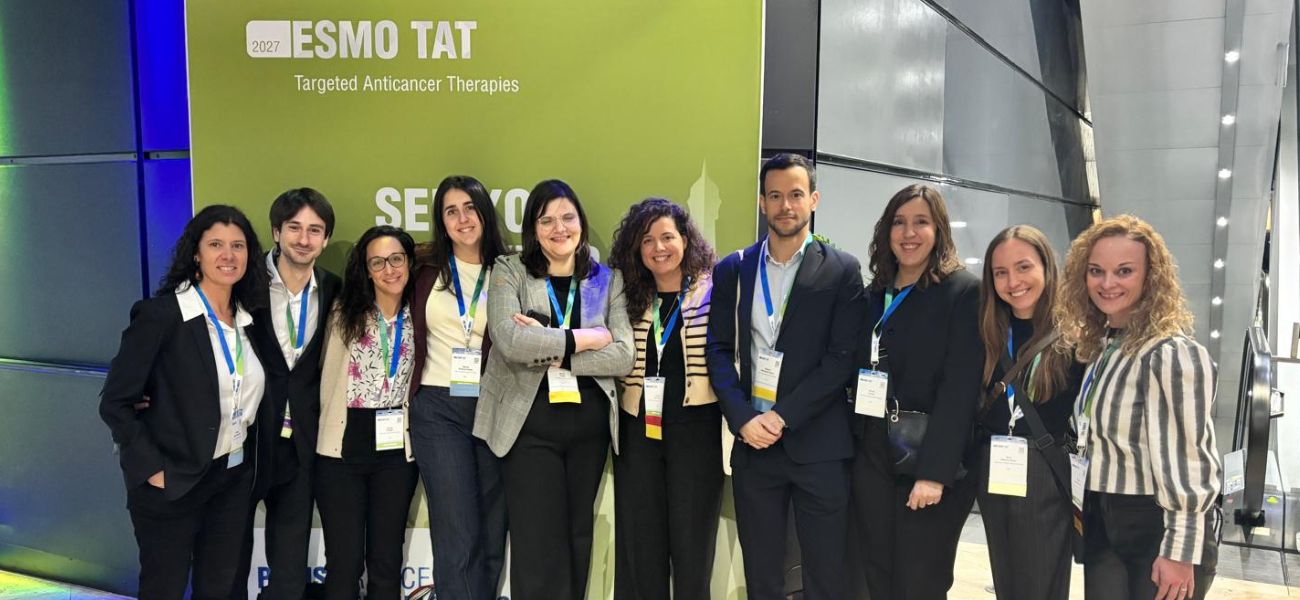
VHIO played a prominent role at the ESMO Targeted Anticancer Therapies (TAT) congress, one of the leading international forums in targeted cancer therapy research, held from March 16–18 in Paris. The meeting was co-chaired by Dr. Elena Garralda, Director of the Research Unit for Molecular Therapy of Cancer UITM – CaixaResearch and Head of VHIO’s Early Drug Development Group, and featured a strong scientific contribution from the institute, including two oral presentations—one of which was selected as a highlight by the conference organizers.
The VHIO-led study, also highlighted by the congress organizers, examines how the new European In Vitro Diagnostic Regulation is affecting clinical trial activation timelines and underscores the need to optimize regulatory processes to ensure patient access to innovative therapies.
Ana Matres, Head of VHIO’s Phase I Clinical Trials Office, presented an oral communication at the congress analyzing the impact of implementing the In Vitro Diagnostic Regulation (IVDR) on cancer clinical research.
This new European regulation establishes stricter requirements for the validation and use of in vitro diagnostic tests, including those used to identify biomarkers for patient selection in clinical trials. “Its goal is to strengthen the safety and reliability of these tests, which are key to the development of precision oncology. However, its implementation introduces new regulatory steps when clinical trials use diagnostic tests that do not yet have CE marking, requiring additional authorizations within a regulatory environment that is not yet fully harmonized across European countries or aligned with clinical trial regulations,” explains Ana Matres, first author of the study.
Increased trial activation timelines
The study, based on a retrospective analysis of the VHIO Clinical Trials Office database, reviewed timelines for submission, authorization, and activation of clinical trials between 2023 and 2025 under the European Clinical Trials Regulation (EU-CTR) and IVDR. A total of 502 clinical trials were analyzed: 451 regulated solely under EU-CTR and 53 that, due to the use of a non-CE-marked in vitro diagnostic test, also required authorization under IVDR.
The most frequently assessed biomarkers included PD-L1, HER2, and KRAS, while the most commonly used techniques were immunohistochemistry, next-generation sequencing (NGS), and PCR.
The results show that the incorporation of IVDR is associated with a significant increase in activation timelines. Time to final regulatory approval was 194 days with IVDR versus 112 days without this requirement. Similarly, time to trial opening at the site was 270 days versus 221 days, respectively.
Although improved coordination between both regulatory pathways is observed over time, the data reflect the initial impact of this new regulation on study start-up timelines.
“These findings highlight the need to optimize regulatory mechanisms and coordination across European frameworks to prevent delays from affecting patient access to innovative clinical trials,” says Dr. Elena Garralda, Director of VHIO’s UITM-CaixaResearch and senior author of the study. “In this regard,” she adds, “European initiatives such as EU COMBINE, aimed at addressing the challenges arising from IVDR implementation, will be key to improving regulatory efficiency and safeguarding Europe’s role in oncology research.”
 VHIO stands out at ESMO TAT
In the same session, Dr. Francesco Bruzzone, fellow of VHIO’s Early Drug Development Group, presented the communication “Outcomes of patients (pts) treated with ESCAT I–II targeted therapies (TT) in early phase clinical trials (EPCTs)”.
Dr. Xavier Maldonado, Head of VHIO’s Radiation Oncology Group, delivered an educational session on synthetic lethality through radiotherapy, while Dr. Victoria Sánchez, from VHIO’s Early Drug Development Group, gave another educational session on the current and future use of DNA damage repair inhibitors.
The following posters were also presented:
140P – Non-detectable circulating tumor DNA (ND-ctDNA) in patients (pts) with advanced solid tumors enrolled in an academic molecular prescreening program (MPP)
Dr. Alberto Hernando-Calvo, medical oncologist at UITM-CaixaResearch
151P – Variables influencing biopsy adherence: Lessons from the cancer core europe (CCE) clinical trial basket of baskets
Marta Rotxés, Coordinator of VHIO’s Phase I Clinical Trials Office
152P – Adoption of ESMO guidelines for germline testing after tumour-only sequencing in patients (pts) with advanced cancers
Susana Aguilar, Head of VHIO’s Biobank (VHIOTECA) and Molecular Pre-screening Program
Final del formulario