
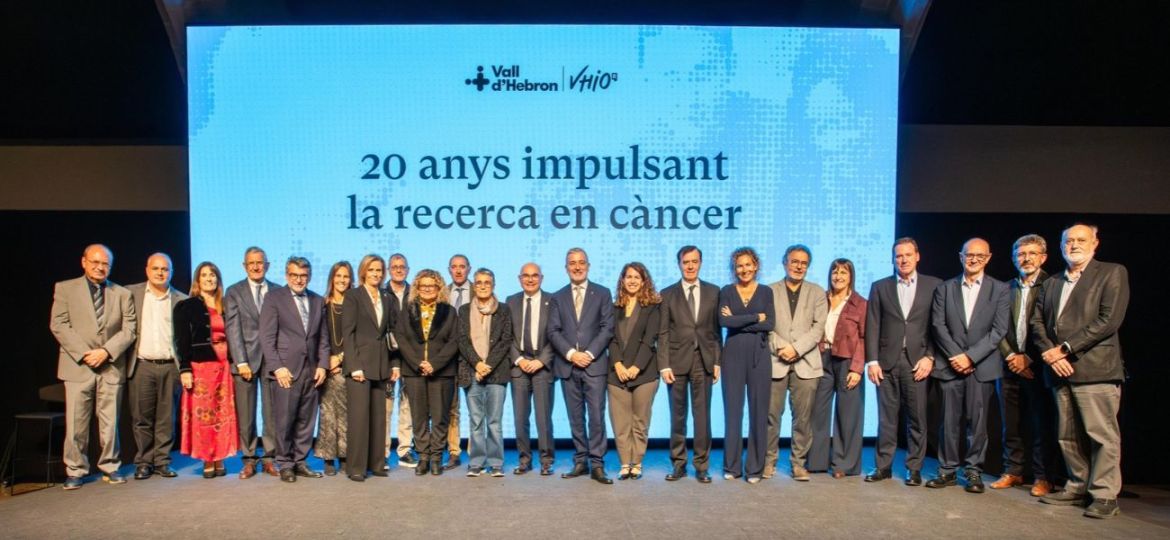
Vall d’Hebron Institute of Oncology (VHIO) celebrated its 20th anniversary yesterday with an institutional event at Barcelona’s Llotja de Mar, attended by more than 300 people. The celebration focused on the people who have made the institute’s 20-year journey possible and the connections between them: a network bringing together biomedical and clinical research, patient care, institutional support and society’s generosity to advance the fight against cancer.
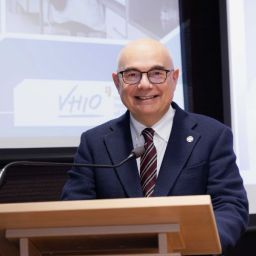
Hosted by journalist Adam Martín, the event featured the Honourable Olga Pané, Minister of Health of the Government of Catalonia; His Excellency Jaume Collboni, Mayor of Barcelona; and Dr Josep Tabernero, Director of VHIO and Head of the Medical Oncology Department at Vall d’Hebron University Hospital, among other dignitaries. It also gave professionals and patients a voice, showing how scientific advances in recent years have made a real difference to people with cancer and how research has, in many cases, changed the diagnosis and treatment of the disease.
“Twenty years ago, we committed to a model that integrated research and clinical practice. Today, we know that this integration has enabled us to turn scientific discoveries into new opportunities for thousands of patients. Above all, this anniversary recognises everyone who has made this possible,” says Dr Josep Tabernero, Head of the Medical Oncology Department at Vall d’Hebron University Hospital and Director of VHIO.
From a pioneering vision to a collaborative network
The central theme of the event was the creation of a network that grows as new nodes connect. This network began with Dr Josep Baselga’s pioneering vision: a translational research model that brings clinical and biomedical research together in a shared setting—in this case, the Vall d’Hebron Campus—to ensure that laboratory discoveries reach patients as quickly as possible. This idea led to the creation of VHIO, officially established in 2006. Under the subsequent leadership of Dr Josep Tabernero, the project evolved into the internationally renowned institute it is today.
Each node in this network represents people who contribute knowledge, experience, trust or resources. The connections between them explain how the VHIO model works: needs identified in the clinic generate research questions; laboratory teams seek answers; and clinical research enables the evaluation of new diagnostic and therapeutic strategies. In turn, insights gained from patients open up new avenues of laboratory research.
VHIO’s integration within the Vall d’Hebron Campus has been key to sustaining this exchange. The proximity of researchers, doctors, nurses and other healthcare and support teams facilitates collaboration and ensures that patients’ needs are both the starting point and the ultimate focus of research.
“The Vall d’Hebron Campus’s commitment to research excellence is part of our commitment to people’s health. Integrating research and care at every level allows us to address questions arising directly from patients’ needs and rapidly translate scientific advances into clinical practice. The success of the VHIO model demonstrates the value of this shared environment and encourages us to continue strengthening it,” explains Dr Albert Salazar, Chief Executive of Vall d’Hebron University Hospital.
This collaborative work has helped advance our understanding of tumour biology, identify biomarkers and select treatments based on the molecular characteristics of each cancer. It has also driven the development of tools such as liquid biopsy and molecular prescreening, as well as more innovative clinical trials and new immunotherapies and cell therapies for solid tumours.
Over twenty years, VHIO has grown from four laboratories occupying 400 square metres into a community of more than 900 people from 45 countries, with 36 research groups and over 12,000 square metres of workspace. Its work has generated more than 5,000 scientific publications and contributed to the approval of nearly 80 new drug indications now used in clinical practice worldwide.
Patients as active participants in research
The celebration placed people with cancer at its centre, recognising that their participation is essential to advancing research. Their testimonies showed how precision oncology, immunotherapy and access to treatments through clinical trials can change the course of the disease and improve quality of life.
The event also recognised their trust and generosity. Taking part in a clinical trial, providing samples for research or sharing their experience of the disease helps generate knowledge that may benefit other patients. Over the past two decades, more than 21,800 people have participated in the over 9,700 clinical trials and studies in which VHIO has been involved, with a strong emphasis on early-phase treatment development.
The gathering paid tribute both to people living with the disease and to the professionals who support them, putting a human face to the connection between research and cancer care. It also provided a space to highlight the needs and questions that remain unanswered and are a priority for VHIO.
Institutional support and society’s generosity
This network extends to VHIO’s Board of Trustees, comprising the Government of Catalonia, the Cellex Foundation, the FERO Cancer Research Foundation, the ”la Caixa” Foundation, the BBVA Foundation, the CRIS Cancer Foundation and the Scientific Foundation of the Spanish Association Against Cancer. Their commitment has helped sustain the institute’s work and support scientific programmes and infrastructure essential to its development.
Patient associations, donors, companies and partner organisations are also part of this journey. Their contributions have helped expand research capacity and develop projects that connect society’s solidarity with advances in oncology.
The event concluded with a conversation between journalist Adam Martín and Barcelona’s Councillor for Health, People with Disabilities and the Strategy Against Loneliness, Marta Villanueva, who highlighted how the city has become a biomedical research hub in recent years, attracting researchers from around the world.
Having VHIO is “a source of pride for the city,” said Marta Villanueva, because it allows us to “attract and retain scientific talent through skilled, well-paid jobs that guarantee the city’s young scientists the right to stay.” In the face of science denial, the councillor said that institutions must invest in science and work in “cooperation with universities, hospitals and research centres.” In this regard, she concluded that investment in the new VHIO building “will consolidate the scientific hub while expanding and strengthening sports, civic and cultural facilities in the Sant Genís dels Agudells neighbourhood.”
Finally, Minister of Health Olga Pané, who closed the event in conversation with journalist Adam Martín, highlighted the role of the VHIO model in Catalonia’s research and healthcare system. She also outlined the challenges facing the institute and how institutions can continue to strengthen this translational research model.
“Thanks to VHIO, nearly 80 new drug indications have been approved and are now part of clinical oncology practice, not only in Catalonia but worldwide,” Pané stressed, highlighting the effort behind the nearly 10,000 clinical trials that VHIO has led or participated in over these 20 years.
Regarding public–private collaboration, the Minister of Health said that VHIO “is an outstanding example of a winning formula based on the combination of professional leadership, institutional backing and support from civil society.”